Showing posts with label tourism. Show all posts

Thursday, 30 January 2014

Art Noveau Church In Freezing Moscow

January is dragging to the end, inevitably, but extremely slowly, and to make things worse, it’s been bitterly cold. Moscow is frozen, moving reluctantly, and walking anywhere feels more uncomfortable than anything else. It’s a time to wrap yourself up in warm fluffy scarves, cook mulled wine and ginger Pu-erh.

With a winter spell on me, I feel like the rest of the city, numb in the cold, and writing is slow and painful. I’ve been long flirting with the idea to start a cycle of stories on Moscow art noveau; in fact, I have started translating a major article about art noveau in Moscow that I wrote for Code de Vino Magazine last autumn. But so far the struggle has been unequal, and the article is not yet ready.
But as I was feeling compelled to write of at least something, a brilliant attraction right beside my office came to my rescue. It’s in two minutes’ walk, and it’s absolutely adorable.
So meet the Old Believers' Church of Intercession of Theotokos.


Well, not that I can always really remember names of Russian churches, especially given that the names in Russian sound complex and solemn, and have hidden meanings that affect translation. This particular name (Церковь Покрова Пресвятой Богородицы, Tserkov Pokrova Presvyatoy Bogoroditsy) is very widespread in Russia; it can also be rendered as the Church of the Veil of Our Lady, since Pokrov in its original meaning is actually a veil that in the Orthodox tradition the Virgin spread over the craving people. I personally prefer to remember location, not names. The Church address is Maly Gavrikov Lane 29, and it’s close to Baumanskaya metro station.

 Google Maps
 
 
Yandex Maps


This cleared up, there is another fact that is worth a special comment. The church used to belong to an Old Believers’ community, Old Believers being a branch of the official orthodox religion. For centuries their belief was outlawed, and at the same time a lot of prosperous merchants and talented people practiced it in total secret. When the Old Believers were eventually inlawed in 1905, a cultural explosion followed, and we can now admire masterpieces created by or for them.
First decade of the 19th century was a time when art noveau blossomed. In Russia, art noveau is called modern, and there are a lot of the style varieties. In our case this is the so-called “northern modern”, a term recognised only in Russia, its next-of-kin being the National Romantic style typical to the Scandinavian countries.
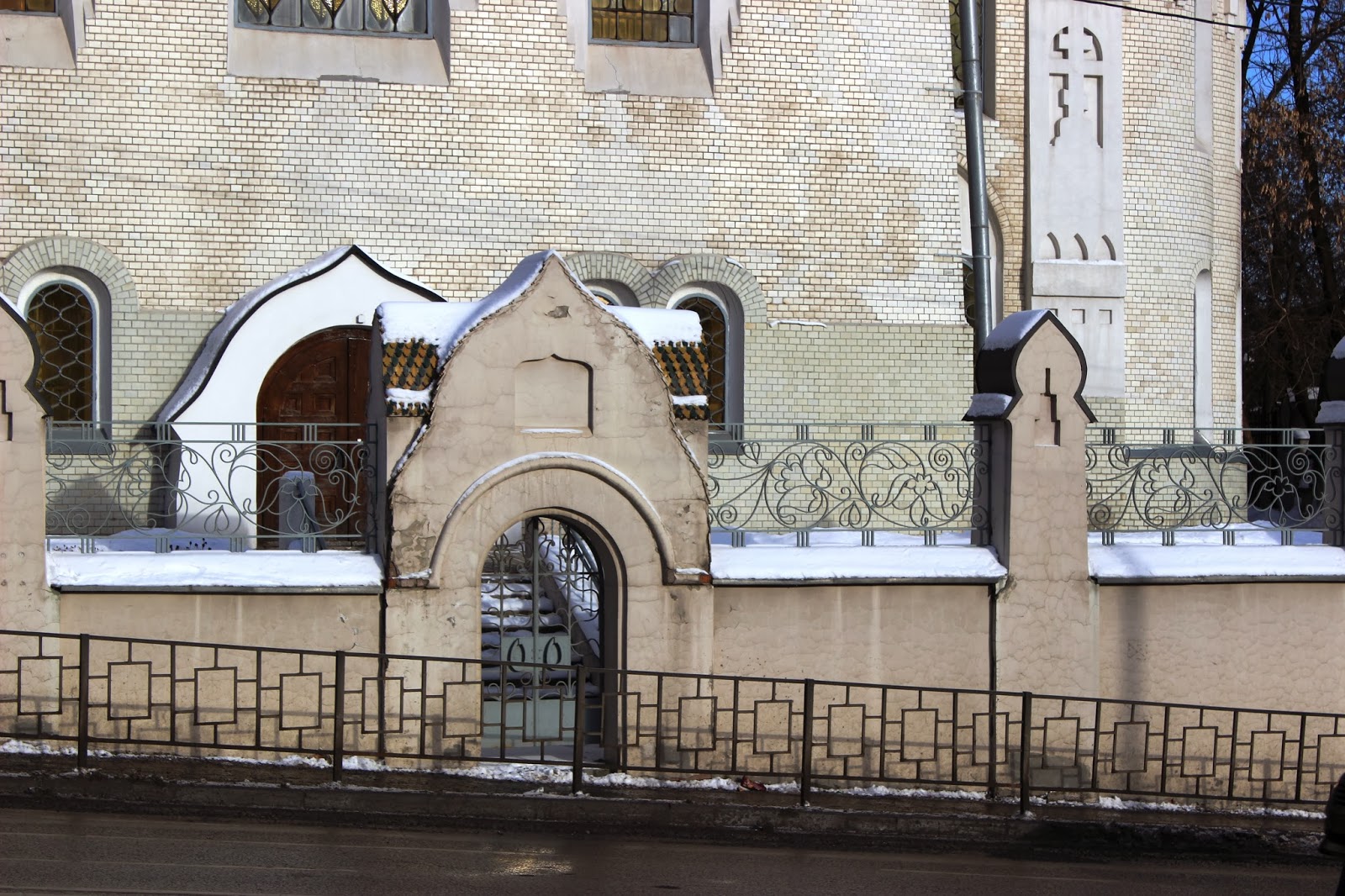
As you can see on the photos, northern modern features shapes and patterns one can see in northern architecture and nature. Shapes are bulky, colours are subdued, and only coloured maiolica is used in abundance to cover the onion domes. Textures contrast each other, forms vary, and the whole building appears as a fairy-tale cloud hovering above the frozen cement underneath, hidden among blocks of flats.  


And here’s the architect, Ilya Bondarenko.

 
He was a pioneer of northern modern and an eminent Russian architect. He is the author or co-author of more than 50 buildings of varied scale and application. After the Revolution of 1917, he focused his efforts mainly on museum management and preservation and restoration activities.
The church I’m describing was laid down in 1909. It was the first church in Moscow to be built of reinforced concrete, with abundant decoration and precious icons inside. The domes are covered with maiolica slates, and somehow they resemble snake’s scales, a telltale art noveau symbol.


In the Soviet time the church bells and crosses were dismounted, and currently the church hosts a gym and a boxing training center.


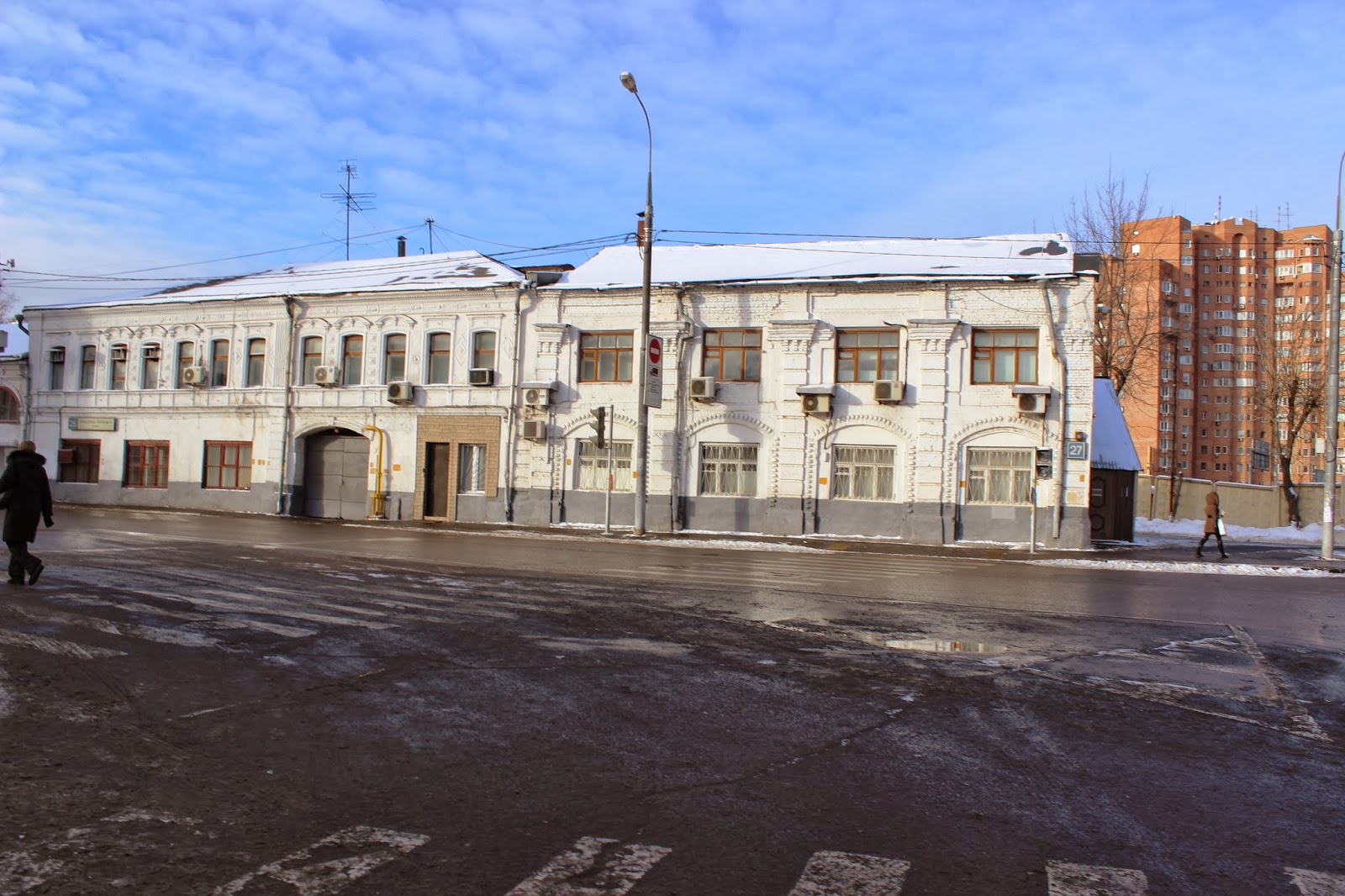
Finally, a couple of pictures of the surrounding old houses dating back most likely to the 18th century.


Wednesday, 11 December 2013

Shukhov Tower: we start off exploring!

It rises up against the dark blue sky of the night city, mighty and slender, translucent and glowing golden. The charming intricacy of steel beams, the inviting character of the elegant constructivist design…

It might as well be the Eiffel Tower, but we’re in Moscow, and here it’s the Shukhov Tower, the seldom mentioned Moscow masterpiece. Let’s take a quick look…  


 … and go explore!

Well, that’s how it looks like on the city map.

This is Google Maps: 


And this is Yandex.Maps which I actually recommend to use if you can read Russian. Even if not, you can sometimes also drag some bits of useful information for your walk. The grey, orange and brown (or what is supposed to be brown) dots are the nearest metro stations to the indicated site. You can see the distance to them in light grey (“м” stands for meters, “км” for kilometers). 
 

 Yandex.Maps are Russia specific, maybe even Moscow specific, and therefore you will find much more places of attraction here than in Google, where I had to put the green arrow myself.

With this sorted out, our walk finally starts.


The metro station nearest to the tower is Shabolovskaya, Orange line. It was built in 1962, much later than the tower itself, but the constructivist features are easily detected. Check out the ceiling lamps design.  


And the stained glass wall panel depicting the Shukhov Tower.  


We go out to Shabolovka St. It is one of the oldest streets in Moscow, and since the streets used to be named after town they led to, so Shabolovka St. was named after the Shabolovka village. We can be quite certain that the street was already there back in mid XVIII, but it never was a major street. Before the XX century it was all wooden houses with gardens and orchards, some small changes happening closer to the end of the XIX century, when merchants chose to settle here in stone 3- or 4-floor houses. The XX century meant erection of a mechanical plant, a brewery, a tramway depot, and finally a radio/TV tower in the area. Still, the street is green and quiet. Well, maybe not that green in winter, but it has a very cosy feeling about it.


Now round the corner and to the left, and we can see the whole of it. The Shukhov or the Schabolovka Tower.  


The second name is much more in use, but to me the first variant is preferable. Because we owe it to him, to Vladimir Shukhov.
  
 
It’s incredible just to think how much he did for Russia, how outstandingly brilliant he was. A great engineer, he designed and supervised construction of the first Russian oil pipelines (hugely important for Russia, eh?), the first Russian oil treatment plant with oil cracking units, he invented and was the first to use hyperboloid structures in civil engineering. The tower in Moscow is just one example of these. Others include Air traffic control tower in Barcelona, Sydney Tower, Tower Infinity in Seoul, and… so many cooling towers typical of any city landscape.
 
He played a significant role in designing process, and though not an architect, he defined the style of many buildings in Russia and especially in Moscow through his input. Now that I’m thinking of it, these places deserve a separate post J
 
As Shukhov worked on the tower project in the early 1920s, the design height was 350 meters. The hyperboloid design of the tower implies that the tower is built of many hyperboloid sections consisting of many straight steel beams fixed to steel rings. As a result, the openwork grid structure is very lightweight, but resistant to high wind loads, which is a dominant load for tall buildings. If compared to the Eiffel Tower, one height unit of the Shukhov Tower required one third of the metal used for the tower in Paris. Unfortunately, due to the metal shortage during the Civil War, the smaller design was brought to life in 1922, with the tower reaching only 148.3 meters above the ground.
 
 
Unlike the Eiffel Tower, it was never meant to be a tourist attraction, and even now you can only walk around, which I did. But I can say every step is worth it, because it is so unmistakably Moscow-like! And it is so beautiful in December blizzard!
 
 
The floodlamps lighting the tower
 
 
The beastly cold Russian winter ;) 
  

Houses across the streets. One is constructivist, the other belongs to the late Khruschev – early Brezhnev era.  


It was a beautiful peaceful Moscow evening for me. Fancy a walk to see it yourself? J


Friday, 6 December 2013

Hi from LoveMoscow!

Well, here it finally starts!

It's been a long while since I started dreaming of a blog dedicated to Moscow and addressing the city guests who would like to make a closer acquaintance. Moscow is not all Red Square and the Kremlin. And although this might seem just too evident, in the real world tourists tend to overlook the city nature. And that’s nothing to be wondered at, since Moscow charming corners reveal oneself only if you are on the search for them…

Well, as I constantly am, I’m going to show them to you, the only thing now is to… puzzle out how to manage blogs ;)

Three pictures for a start of little Moscow sidestreets. Like it?